
 Step 1: Choose the Right Type of Grocery Store
Before starting a grocery store business, the first step is to decide which store format suits your budget, location, and target customers.
| Store Type | Best Suitable For | Description |
|---|---|---|
| Local Kirana Store | Small neighborhoods and residential areas | A traditional grocery shop that serves the daily needs of nearby customers with basic grocery and household products. |
| Mini Mart / Mini Supermarket | Low to medium investment business | A compact self-service store with organized racks, billing counter, FMCG products, grocery items, and better shopping experience. |
| Supermarket | High-footfall locations and bigger markets | A larger retail grocery store with multiple product categories, spacious layout, organized departments, inventory management, and higher growth potential. |
| Organic or Health Store | Premium and health-conscious customers | A specialized grocery store focused on organic, healthy, premium, and specialty food products. |
| Online Grocery Store | Delivery-focused business model | A grocery business that accepts orders through a website, app, WhatsApp, or phone and delivers products to customers. |
| Home-Based Grocery Store | Very low investment setup | A small grocery business operated from home, garage, or a small space with limited products and local customer reach. |
If you are starting for the first time, a local kirana store or mini mart can be a practical option because it requires lower investment and is easier to manage. If you have a bigger budget and a high-footfall location, a supermarket model can be a better choice for long-term growth.
 Step 2: Make a Simple Business Plan
You don’t need a formal document. Just answer these key questions:
Where will the store be located?
What size store can you afford?
Who are your customers? Families, working professionals, students, etc.
What products will you stock?
How much will you invest initially?
Will it be cash only or UPI/card enabled?
Will you offer delivery?
 Step 3: Choose a Location
Your store’s location is crucial for success. Consider:
High footfall residential area
Near apartment complexes, schools, offices, or bus stands
Easy accessibility and parking
Low-to-moderate rent (preferably under 10–15% of expected revenue)
 Ideal shop size:
Small kirana: 100–200 sq ft
Mini supermarket: 300–700 sq ft
 Step 4: Set Up the Store
What you need:
Shelves & racks: Wooden or metal racks (used ones if on budget)
Refrigerator: For dairy, cold drinks, etc.
Counter & billing setup: Basic cash drawer or POS machine
Lighting & cleanliness: Well-lit and organized space
Shop board: Name + FSSAI number (if available)
 Estimated setup cost: ₹30,000 to ₹2,00,000 depending on shop size
 Step 5: Legal Licenses and Registration
Here are the key licenses you need:
| License | Why Needed | Cost |
|---|---|---|
| FSSAI License | Mandatory for selling food items | ₹100–₹2000/year |
| Shop & Establishment License | Register your business with municipality | ₹500–₹1000 |
| GST Registration | Required if turnover > ₹40 lakhs/year | Free |
| Trade License (in some cities) | Basic legal permission to operate | ₹500–₹1500 |
Apply for FSSAI online at https://foscos.fssai.gov.in
Step 6: Decide What Products to Stock
Start with high-demand, fast-moving items:
Essentials:
Staples: Rice, wheat, flour (atta), sugar, pulses
Oils & ghee
Salt, masala, pickles
Snacks: Biscuits, chips, namkeen
Beverages: Tea, coffee, cold drinks
Dairy: Milk, curd, paneer, butter (via distributor tie-up)
Personal care: Soap, shampoo, toothpaste, etc.
Cleaning: Detergent, phenyl, toilet cleaner
 Initial stock budget: ₹50,000 – ₹1,50,000 depending on shop size
 Step 7: Choose Your Suppliers
Get products at wholesale rates from:
Local distributors
Wholesale markets
Cash & carry chains: Reliance Market, Metro, D-Mart, etc.
B2B apps: Udaan, Jumbotail, BigBasket for Business, Meesho
 Start small, but keep track of expiry dates and fast/slow-moving items.
 Step 8: Setup Billing & Inventory System
Options:
Manual Ledger – for small shops
Mobile Billing Apps – like Vyapar, Khatabook, or myBillBook
POS System – for larger stores (₹8,000+)
 Accept UPI, QR code payments (Google Pay, PhonePe, Paytm)
 Step 9: Promote Your Grocery Store
Even a local grocery store needs basic marketing.
Budget-Friendly Marketing Tips:
Print flyers for nearby homes
Put a visible shop board with your offers
Offer loyalty card or cashback on repeat orders
Create a WhatsApp group for customers
Give small freebies: a ₹5 gift for purchases above ₹500
 Offer free home delivery in nearby areas to stand out.
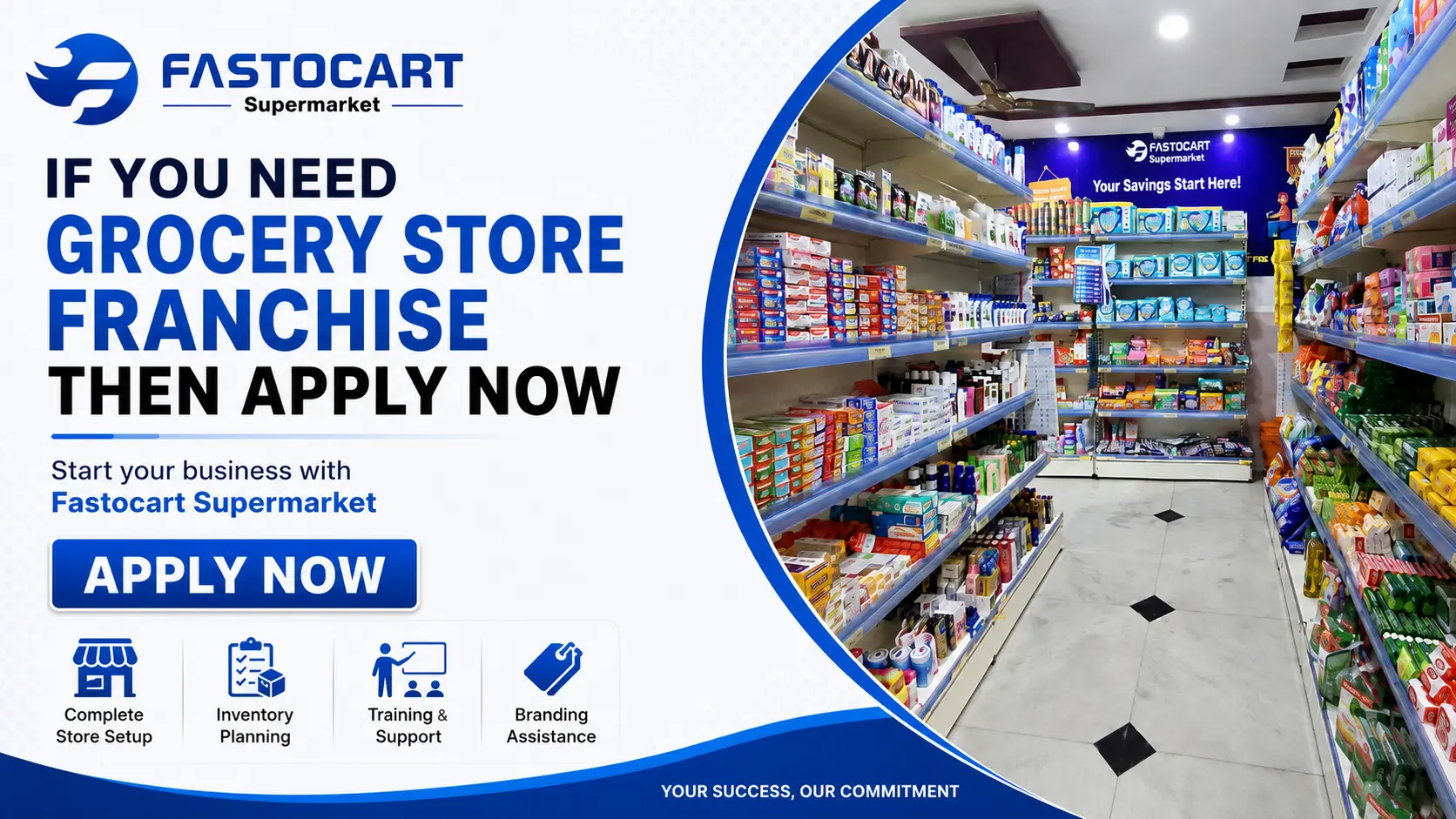
Start Your Supermarket Franchise Journey Today!
Want to be your own boss? Fastocart helps you launch a successful Supermarket franchise in your city.
Fill out the form below — our team will contact you with all the details.